Saturday, 29 November 2014

Post Pop: East Meets West - Saatchi Gallery (part 2: West)

Peter Halley, Prison with Yellow Background, 1984
Post Pop: East Meets West is at the Saatchi Gallery until 23 February 2015.
The Saatchi Gallery’s new show is a large scale encounter between British and American  ‘Post Pop’ and  Oriental artists from China, Taiwan and the former Soviet Union, who have adapted something of the flavour and attitude of Western Pop to their own cultural contexts. Clearly, such a large show (more than 100 artists) will produce mixed results. However, it is refreshing and instructive to be confronted with a broadly familiar visual language inflected with different accents and a different sensibility.
I realize that the point of such an exercise is to mix things up – however, I found that I could better get a handle on the content and the cultural contrasts by separating out East and West. So, I have selected my parallel top 10 exhibits – albeit selected from reproductions rather than an encounter in the exhibition itself. This is Part 2: West. (Click here for Part 1: East.)
Read reviews by Waldemar Januszczak and Jonathan Jones.
(NB artists are listed in alphabetical order; click on images to enlarge.)
Mike Bidlo,  Not Warhol (Brillo Soap Pads Box Pasadena Type, 1969), 1991
Glenn Brown, Reproduction, 2014
Michael Craig-Martin, Untitled (High Heel), 2014 
Gary Hume,  Four Coloured Doors I, 1989-90
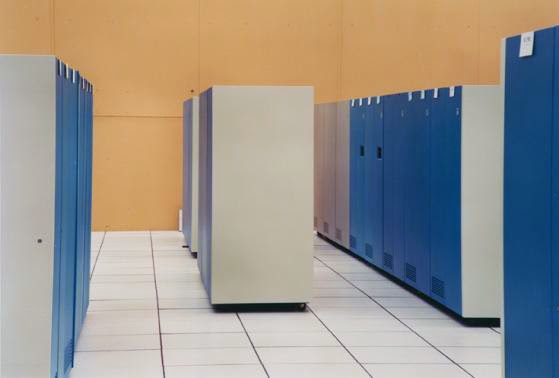
Clay Ketter, Suckerpunch Motel Wall, 2001
David Mach,  M & M (Mao from Mao & Marilyn), 2014
Lisa Milroy, Shoes, 1990
Julian Opie,  This is Shahnoza, 46, 2007
Richard Woods,  Nature Making, 2014
(Click here for Part 1: East)
Tuesday, 25 November 2014

Lewis Baltz, 1945 - 2014

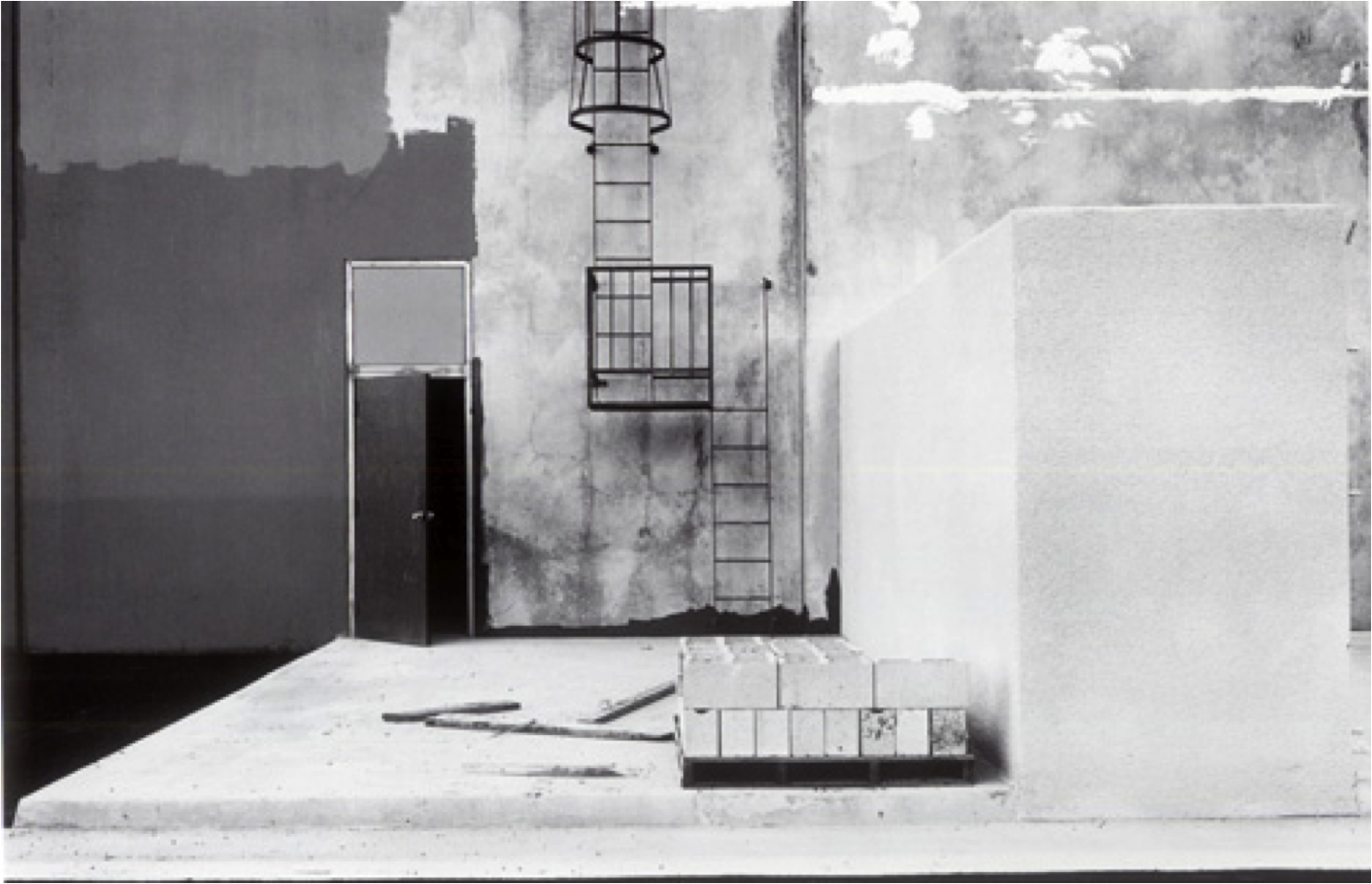
Lewis Baltz, from The New Industrial Parks, 1974
Lewis Baltz died on 23 November 2014.
One of my favourite photographers.
Lewis Baltz' most famous series of photographs, The New Industrial Parks, Near Irvine, California (1973-75) offers a remarkable contrast to the traditional, Romantic concerns of landscape photography: instead of natural beauty and the sublime Baltz shows us the facades and structural details of anonymous, prefabricated industrial units and parking lots. While the series clearly constitutes a critique of urban sprawl - the relentless spread of a 'man-altered landscape' - at the same time Baltz' precise Minimal aesthetic, crisp, formal composition and attention to details and textures make these very beautiful pictures.
Baltz was included - alongside Robert Adams, Joe Deal, Frank Gohlke, Nicholas Nixon, John Schott, Stephen Shore Henry Wessel Jr, Bernd and Hilla Becher - in the seminal exhibition New Topographics: Photographs of a Man-Altered Landscape in 1975 in which the participants collectively proposed an aesthetics of the banal.
In addition to The New Industrial Parks (1973-75), Baltz' work includes (amongst others): The Prototype Works (1967-76), Tract Houses (1971) and Sites of Technology (1989-91), from which the examples below are selected.

Read an obituaries by Gerry Badger and Sean O'Hagan; read the 'last interview' at L'Oeil de la Photographie; watch a short video of Baltz talking abut his work on the Tate website;  read more interviews with, and articles about, Baltz at American Suburb X; read an article about New Topographics by Kelly Dennis: Landscape and the West: Irony and Critique in New Topographic Photography

The Prototype Works (1967-76)

Tract Houses (1971)

The New Industrial Parks (1973-75)  

Sites of Technology (1989-91)

Saturday, 15 November 2014

Chris Bracey, 1954 - 2014

Chris Bracey died on 1 November 2014.
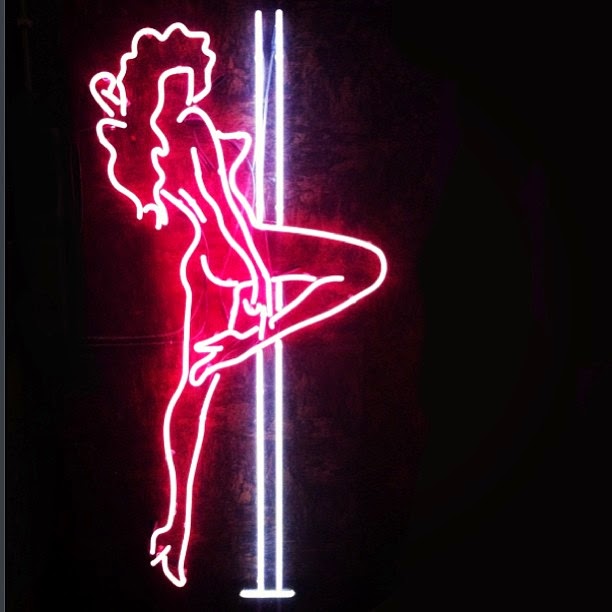
I confess that I had not heard of Chris Bracey ('the Neon Man') until I read his obituary. However, as a fan of neon (see blog entry below on the centenary of neon) I found his story interesting. As a young man he worked for his father's company Electro Signs making neon signs for circuses and amusement arcades; Chris' innovation was to take the business to Soho and the sex industry. For 20 years he supplied the neon 'glamour' for sex shops and clubs. In the 1980s an art director of film saw him erecting a sex shop sign and commissioned him to do work for film sets - his work has been used in Batman, Blade Runner, Charlie and the Chocolate Factory, Eyes Wide Shut and many others. In 1998 he saw the Bruce Nauman exhibition at the Hayward Gallery and was astonished to discover that neon works could be art! Since then, in addition to his own creations he has made work for artists including Martin Creed (the whole world + the work = the whole world). To be sure Bracey's own work is more kitch and 'Vegas' than Nauman or Creed, but his workshop and collection - "God's Own Junkyard" in Walthamstow looks like an amazing place.
Read obituaries in The Guardian  and The Telegraph.
Vlick on images to enlarge.

Sunday, 9 November 2014

Andy Warhol - Tate Liverpool

Andy Warhol, Untitled (Marilyn), 1967
Transmitting Andy Warhol is at Tate Liverpool until 8 February 2015.
Oh, to be in Liverpool, now that Warhol is there! In the meantime, here is my Warhol Transmission.
This exhibition includes some great pieces - Marilyn Diptych (1962), Brillo Soap Pad Boxes (1964/8), Campbell's Soup (1968), Flowers (1964/5), 'Untitled (Electric Chairs)' (1971) and many more. But the exhibition also focuses on Warhol's use of, and interventions into, mass media - from illustrations for Vogue and Harper's Bazaar, the publication of his magazine Interview and poster design to his use of silk screen printed versions of his paintings to make his art genuinely affordable and available to a wide public; the exhibition also includes an evocation of Warhol's involvement with The Velvet Underground and the multi-media events of the Exploding Plastic Inevitable (EPI). (Scroll down to play a film of the EPI as well as screen tests for Edie Sdgewick, Lou Reed, Nico and Bob Dylan.)
Read reviews of the exhibition by Laura Cumming, and Karen Wright.
PS - see also blog entry below on the publication of a book of Billy Name's photographs of Warhol's Factory.
Andy Warhol, Untitled (Marilyn), 1967
Andy Warhol, Marilyn Diptych, 1962
Andy Warhol, Campbell's Soup, 1968
Andy Warhol, Three Brillo Soap Pad Boxes, 1964/8 (installation at Tate Liverpool)
Andy Warhol, Dance Diagram, 1962
Andy Warhol, Untitled (from Electric Chairs), 1971


Billy Name: The Silver Age: Black and White Photographs from Andy Warhol’s Factory

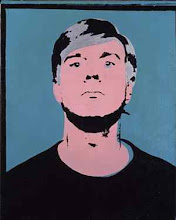
Billy Name, Andy Warhol with Self-Portrait, 1967
A new book of Billy Name's photographs of Andy Warhol's Factory has just been published, making the perfect complement to Tate Liverpool's exhibition Transmitting Andy Warhol (see blog entry, above). As Glenn O'Brien's article explains, Billy Name was invited by Warhol to decorate his new loft space - The Factory - which he did by spraying everything silver. It was a big job, so Name asked if he could move in. He did, and stayed for many years becoming Warhol's lover/companion, secretary, studio manager and more - but, above all, he became the Factory archivist documenting the style, the people and life inside Warhol's studio.
Billy Name: The Silver Age: Black and White Photographs from Andy Warhol’s Factory is published by Reel Art Press; read the article by Glenn O'Brien.
Billy Name, Factory Group Shot, 1968
Billy Name, Nico, 1967
Billy Name, Lou Reed at the luncheonette on the corner of 47th Street and 3rd Avenue,1967
Billy Name, Bob Dylan, 1965
Billy Name, Andy Warhol on the Couch at the Factory, 1967
Billy Name, Andy Warhol with Brillo Box sculpture and Ruby the cat, 1964

Sunday, 2 November 2014

Late Turner - Tate Britain

J.M.W. Turner, Norham Castle, Sunrise, c1845
Late Turner - Painting Set Free is at Tate Britain until 25 January 2015.
Mike Leigh's film Mr Turner has been released to ecstatic reviews (Observer, Guardian, Telegraph) and should make for an enjoyable complement to the Tate's equally well received exhibition of the artist's late work. The exhibition surveys Turner's paintings made between 1835 when the artist was 60 and 1851 when he died. Although his work was inevitably affected by the infirmity of old age - apparently exacerbated by the consumption of alcohol to counteract a hand tremor associated with the onset of Parkinson's disease which in turn led to diabetes (see Dorment) - Turner produced some astonishing work in this period ranging from the luminous ethereality of Norham Castle, Sunrise, c1845 (above) to the epic, classical myths and landscapes such as Ancient Rome; Agrippina Landing with the Ashes of Germanicus, 1839 (below).
Read reviews by Peter Conrad, Richard Dorment, Ben Luke  Karen Wright and Jonathan Jones.
Click on images to enlarge.

J.M.W. Turner, Ancient Rome – Agrippina Landing With the Ashes of Germanicus, exhibited 1839
J.M.W. Turner, Modern Rome – Campo Vaccino, 1839
J.M.W. Turner, Peace – Burial at Sea, exhibited 1842

J.M.W. Turner, Snow Storm – Steam-Boat off a Harbour’s Mouth, exhibited 1842
J.M.W. Turner, Light and Colour (Goethe’s Theory) – the Morning after the Deluge – Moses Writing the Book of Genesis, exhibited 1843
J.M.W. Turner, Rain, Steam, and Speed – The Great Western Railway, 1844
J.M.W. Turner, A Disaster at Sea, c1845
J.M.W. Turner, Sunrise with Sea Monsters, c1845
J.M.W. Turner, The Angel Standing in the Sun, 1846