Thursday, 10 April 2014

John Deakin - The Photographers' Gallery

John Deakin, Francis Bacon (Vogue), 1952
Under the Influence: John Deakin and the Lure of Soho is at The Photographers' Gallery 11 April - 13 July 2014.
This is a terrific exhibition. I love Deakin's intense photographs of Francis Bacon, Lucian Freud, George Dyer, Henrietta Moraes and others in the Colony Room circle of 1950s and 60s Soho; oddly, his great prints look even better having been salvaged from Bacon's studio - paint stained, creased and torn.
Sacked twice from Vogue, Deakin, an alcoholic, was clearly a difficult person. Gordon Comstock's profile of him, John Deakin: Champagne and Sulphur in Soho quotes George Melly describing him as a "vicious little drunk of such inventive malice and implacable bitchiness that it's surprising he didn't choke on his own venom". 
The Photographers' Gallery show includes 'rarely seen and un-shown works':  it is very good.
Watch a short video pairing Deakin's less well known pictures of Genoa with Johnnie Shand Kydd's pictures of Naples: A Tale of Two Cities.
Read a review of John Muir's book of the exhibition and a review of John Muir's earlier book A Maverick Eye: The Street Photography of John Deakin.

John Deakin, George Dyer, c1964
John Deakin, George Dyer
John Deakin, Portrait of an unknown girl in a cafe, 1960s
John Deakin, Francis Bacon, 1968
John Deakin, Francis Bacon, 1952
John Deakin, Lucian Freud, c.1961
John Deakin, Lucian Freud,1960s
John Deakin, Henrietta Moraes
John Deakin, Tony Abbro, newsagent, Old Compton Street, December 1960
John Deakin, George Dyer in Francis Bacon's Reece Mews Studio, c.1964

Monday, 7 April 2014

Alan Davie, 1920 - 2014; Tate Britain, Gimpel Fils and Alan Wheatley Art

Alan Davie, Patrick's Delight, 1960
Alan Davie died on 5 April 2014.
BP Spotlight: Alan Davie is at Tate Britain 14 April - 28 September 2014; Alan Davie: The Symbol is Neither Rational nor Concrete is at Gimpel Fils, 24 April - 23 May 2014; Alan Davie: The (Wild) Eye of Wonder: EarlyPaintings 1945-1970 is at Alan Wheatley Art, 9 April - 23 May 2014.
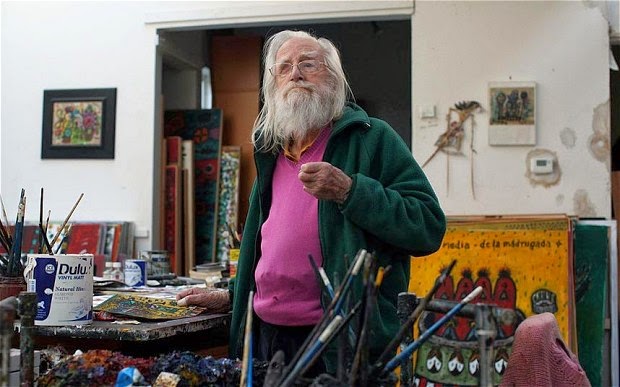
Alan Davie, Scottish painter and musician, one of the major figures of British post-war art has died at the age of 93 just days before 3 London exhibitions of his work open. These shows mark a return to visibility of a prolific artist who had largely slipped from public sight. Davie was one of the first British artists to respond to the achievements of the New York Abstract Expressionists. He encounteered the work of Rothko, Pollock and de Kooning at the 1948 Venice Biennale. 
Davie's 'action' painting method was built on improvisation techniques developed as a jazz pianist and saxophonist as well as Zen Buddhism. The imagery in his work drew from a wide range of sources and interests including Indian, Aztec and Aboriginal art.
Read The Artist that Time Forgot, an article by Mark Hudson written after a recent conversation with the artist; watch a selection of short videos of Davie  discussing his work on the Abstract Critical website and Talking Pictures 14: Alan Davie; read obituaries by Michael McNay, in The Telegraph and at the arts desk.
Alan Davie, Entrance to a Paradise, 1949
Alan Davie, Bubble Figure No.1, 1954
Alan Davie, Birth of Venus, 1955

Alan Davie, Opus O.521C The Horse that has visions of Immortality No.3,1963
Alan Davie, Ankh for the Serpents, 1967
Alan Davie, Entrance for a Red Temple No.1, 1960
Alan Davie, Fairy Tree No.5, 1971
Alan Davie, Altarpiece for Kali, 1980
Alan Davie, photographed by Ida Kar, 1958
Alan Davie, photographed by Eamonn McCabe, 2014

Friday, 28 March 2014

Veronese - National Gallery

Paolo Veronese, Perseus and Andromeda, 1575-80
Veronese: Magnificence in Renaissance Venice is at the National Gallery until 15 June.
Veronese was "one of the greatest painters who have ever lived", is the bold claim of Xavier Salomon, curator of this exhibition; Nicholas Penny, director of the National Gallery is reported to agree with Salomon that The Martyrdom of St George (c.1565, see below) is 'arguably the world's greatest painting'.
I simply haven't seen enough Veronese (yet) to know if this is overwrought hyperbole or sound judgement. But just on the basis of reproductions of paintings such as Perseus and Adndromeda (above) I am ready to be seduced. Reviews, too, have been pretty positive:
"The show of a lifetime. This is the first – and quite likely the last – chance we will have to see his soaringly beautiful art at full stretch in this country." (Laura Cumming)
Veronese (1528-88), born Paolo Caliari in Verona (hence 'Veronese') became one of the leading artists of Venice alongside Titian (c.1490-1576), the sculptor Sansovino (1486-1570) and architect Andrea Palladio (1508-80). He was notable for large scale paintings of mythological and biblical subjects. 
In 1573 Veronese was summoned before the Inquisition to explain the inclusion of inappropriate figures in his painting of the Last Supper: "Did some person order you to paint Germans, buffoons, and other similar figures in this picture?", Veronese responded:  "When I have some space left over in a picture, I adorn it with figures of my own invention… ". Ordered to remove the offending figures 'at his own expense', Veronese simply retitled the painting Feast at the House of Levi (see below - NB not included in exhibition).
Read reviews by Laura Cumming, Waldemar Januszczak,  Richard Dorment; watch a short video of Nicholas Penny talking about the Adoration of the Kings. Click on images to enarge.
Paolo Veronese,The Martyrdom of St George, c.1565
Paolo Veronese, Lucretia, 1580s
Paolo Veronese, Portrait of a Lady, known as the "Bella Nani", c.1560-5
Paolo Veronese, The Adoration of the Kings, 1573
Paolo Veronese, The Conversion of Mary Magdalene, c1548
Paolo Veronese, Mars and Venus United by Love, 1570s
Paolo Veronese, The Feast at the House of Levi, 1573

Monday, 17 March 2014

Martin Creed - Hayward Gallery (and in the lift at Ikon)

Martin Creed, Work No. 845: Things, 2007
Martin Creed: What's the point of it? is at the Hayward Gallery until 27 April.
On a recent visit to the Ikon in Birmingham (see Jamal Penjweny and David Tremlett, below) I took the glass lift down from the top galleries (I love glass lifts) and had the bonus pleasure of experiencing Martin Creed's Work No. 409: For lift and choir of bass, alto and soprano voices. The recorded voices deepen as the lift descends. I immediately rode the lift back up with rising voices; and down again.
This reminded me that Creed's retrospective at the Hayward is on my list of must see exhibitions. I have enthused before about his Turner Prize winning piece (Work No. 160: The lights going on and off - see below) and so have high hopes that the Hayward show will be good. Reviews, have, however, been mixed. His art is one that balances on a knife edge of silliness and banality, but when it comes off it can be a delight.
Read reviews by Tim Adams, Mark Hudson, Sarah Kent and Waldemar Januszczack (he hated it!); watch a video 'preview'; read a transcript of a talk given by the artist in Birmingham in 2008; watch a video of Martin Creed and his band performing in Berlin in 2012.
Martin Creed, Work No. 79: Some Blu-Tack kneaded, rolled into a ball, and depressed against a wall, 1993
Martin Creed, Work No. 200: Half the air in a given space, 1998
Martin Creed, Work No. 1092: Mothers, 2011
Martin Creed, Work No. 264: Two protrusions from a wall, 2001
Martin Creed, Work No. 1315, 2011

Martin Creed, Work No. 88: A sheet of A4 paper crumpled into a ball, 1995
Martin Creed, Work No. 701: Nails, 2007