Thursday, 9 January 2014

A New Objectivity - S | 2 Gallery

Bernd and Hilla Becher, Wassertürme (Water Towers), 1973
A New Objectivity:The Düsseldorf School of Photography is at S | 2 Gallery until 17 January 2014.
I am a bit late with this - I had meant to highlight it back in December, but somehow life got in the way. Then I stumbled across an article entitled Has the Düsseldorf School killed photography? by Grant Scott and was reminded to do so.
The Düsseldorf School refers to a group of photographers associated with, what was, the Kunstakademie Düsseldorf and the teaching of Bernd and Hilla Becher. Typically, they make large-scale work in a deadpan documentary style and include, amongst others, Andreas Gursky, Candida Höfer, Thomas Ruff, Axel Hütte and  Thomas Struth. (I loved Struth's show at the Whitechapel back in 2011 - see below.)
Grant's polemic is not so much aimed at the heroes (my word, not his!) of the School itself but at what he sees as their baleful influence upon the rising generation of photographers - or, at least, the lazy ones! Grant allows that the original disciples of the Düsseldorf School [brought] new ways of seeing but he seems to have little time for the Bechers, whose teaching was so influential. He writes: 
the Bechers photographed industrial landscapes and architecture in stark, graphic black and white, documenting Germany’s industrial past of water towers, mining sites and coal bunkers. Their work was cold, clinical, emotionless and documentary, ... [p]hotography without opinion, without comment or personality.
I love their work!
I am not in a position to argue with Grant about the degree of Düsseldorfian influence on young photographers, but I suspect we see photography (and the world) with different eyes and taste. Grant wants photography with more personality, expression and emotion - I want less!
Whatever else might be said about it, the work in this show will comprise big images, by big names which will, undoubedly sell for big money. (S | 2 belongs to Sotheby's.) Gursky, after all did set an auction record back in 2011 when his fabulous Rhine II sold for a staggering $4,338,500 (see below).

Andreas Gursky, Singapore Börse, 1996
Thomas Struth, Calle Sacchere, 1990
Thomas Struth, Iglesia de San Francisco, Lima Peru, 2003
Thomas Struth, Seamless Tube Production, Tenaris Siderca, Campana, Buenos Aires, 2009
Candida Höfer, Iglesia de Saõ Francisco de Assis Salvador de Bahia I, 2005
Candida Höfer, Bibliotheca Philosophica Hermetica, Amsterdam II, 2003
Thomas Ruff, Nudes OBE 08, 2001
Axel Hütte, Bussaco, 1999

Sunday, 15 December 2013

Martin Sharp, 1942 - 2013

Martin Sharp, Mister Tambourine Man, 1967
Martin Sharp died on 1 December 2013.
Hearing of the death of Martin Sharp took me back to hairy, adolescent days, to what was undoubtedly a formative engagement with visual culture.  As a schoolboy ‘agent’ for selling posters (‘Big O’?), recruited from/suckered in by the ads at the back of New Musical Express I pored over the catalogue in which Sharp’s Dylan and Van Gogh posters stood out. But the one that made the deepest impression was his Max ‘The Birdman’ Ernst: this was certainly my first introduction to the work of Ernst – though it was some time before I twigged that the image was not actually the invention of Sharp but culled from Ernst’s brilliant 1933 collage novel Une Semaine de Bonté. Though my taste later turned more to Ernst than Sharp those early posters (and Cream album covers) made a deep impression.
Read obituaries by Marsha Rowe, Richard Neville (ce-editor of Oz, for which Sharp was art editor) and in The Telegraph.
Martin Sharp, Vincent, 1968
Martin Sharp, cover for Cream's Disraeli Gears, 1967
Martin Sharp, Jimi Hendrix, 1967
Martin Sharp, Max 'The Birdman' Ernst, 1967

Sunday, 8 December 2013

Pauline Boty - Pallant House Gallery

Pauline Boty, The Only Blonde In The World, 1963
Pauline Boty: Pop Artist and Woman is at Pallant House Gallery, Chichester until 9 February 2014.
Boty was one of the stars of British Pop Art - alongside Peter Blake, David Hockney, Derek Boshier, Peter Phillips and others. Her premature death, at 28 in 1966, and the chauvinism of art history mean that she is less well known than she should be. Hopefully this exhibition (first shown earlier this year at Wolverhampton Art Gallery) will help to remedy this.
Read an interesting spat about the show's title and its curatorial perspective between Fisun Güner and the exhibition curator Dr Sue Tate here. Read a review of the Wolverhampton showing by Alastair Sooke and an article by Robin Stummer.
Pauline Boty, 5-4-3-2-1, 1963
Pauline Boty, Colour Her Gone, 1962
Pauline Boty, Bum, 1966
Pauline Boty, Nude Woman ina Coastal Landscape (nd)
Pauline Boty, It's A Man's World II, 1965
Pauline Boty, Countdown to Violence, 1964
Pauline Boty in her studio in 1964 with her now lost painting Scandal '63

Photorealism - Birmingham Museum

John Salt, White Chevy - Red Trailer, 1975
Photorealism is at Birmingham Museum until 30 March 2014.
Guilty pleasures: I know that photorealism has been unfashionable pretty well from its origins in America in the late 1960s, that its artists tend to be unhealthily pre-occupied with a narrow range of arguably clichéd and sometimes kitsch motifs: cars, motorbikes, diners, food, shiny things and, in the case of John Kacere, a lifetime's dedication to painting women's bottoms and crotches. Perhaps the only honourable exception to this relentless celebration of banality is Chuck Close who has tirelessly and inventively explored the representation of the human face in ways which are interesting both as overpoweringly intense portraits and as quasi-abstract paintings. But, but ... I rather like this stuff!
Read a (generally negative) review by Alastair Smart, and listen to a (generally sceptical) discussion on Radio 4's Saturday Review (starts at 35mins).
Ralph Goings, America's Favorite, 1989
Robert Bechtle, Alameda Chrysler, 1981
Richard Estes, Telephone Booths, 1967
John Kacere, Serina '72, 1972
Audrey Flack,  Shiva, 1972-3
Rod Penner, 212 / House with Snow, 1997-8
Raphaella Spence, Vegas, 2011
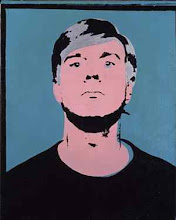
Chuck Close,  Self Portrait, 1977

Friday, 29 November 2013

The Show is Over - Gagosian

The Show is Over - well, it is now: Gagosian's exhibition finished on 30 November. However, I was very pleased to catch it a couple of days beforehand.
Christopher Wool,  Billboard, Carnegie International, Pittsburgh, 1991
A big group show including some big names - Warhol, Serra, Ryman, Twombly, Manzoni, Marden, Prince... (who just happen to be some of my personal favourites) and some that were new to me - Dan Colen, Gregor Hildebrandt, this was (according to the press release) ostensibly about abstraction and the end of painting, often proposed but never concluded. The selected works featured monochromes and a variety of challenges to the limits of painting and to the integrity of the picture plane (eg burning and slashing - by Yves Klein and Lucio Fontana respectively). I would have liked to buy the interesting looking catalogue and explored this idea further - but at £65 that wasn't going to happen! On the other hand, I was happy to come away with a piece of free art, courtesy of a collaboration between Felix González-Torres and Christopher Wool: visitors were free to remove sheets from the solid block formed by a neat stack of posters.
Below is a selection of my favourite pieces in the show. 
Read reviews by Jackie Wullschlager and Dan Coombs. See a video tour of the installation here.

Christopher Wool and Felix González-Torres
Andy Warhol, Little Electric Chair, 1965
Richard Prince, Untitled, 2012 (Rubber band, inkjet, staples, and acrylic on mounted newsprint)
Richard Serra, Elevational Weights, Black Matter, 2010
Robert Ryman, Untitled, 1963
Albert Oehlen, Untitled, 2008
Gerhard Richter, Grau (Grey), 1970
Cy Twombly, Untitled (New York City), 1968

Dan Colen, hippity flippity!, 2012 (Tar and feathers on canvas)

Friday, 15 November 2013

Turner Prize 2013 - Derry-Londonderry

The 2013 Turner Prize is currently showing at Building 80/81, Ebrington, Derry-Londonderry and continues until 5 January 2014. The winner will be announced on Monday 2 December 2013.
The shortlisted artists are: David Shrigley, Laure Prouvost, Lynette Yiadom-Boakye and Tino Sehgal.
Watch a video introduction to the show by Adrian Searle and read reviews by Laura Cumming and Adrian Searle.

David Shrigley
For his Turner Prize installation, Shrigley, best known for his wonky, comic drawings has produced a 7 foot tall, sculpture of an ill-proportioned, male life-model who blinks and periodically pees into a bucket while visitors to the exhibition are invited to draw him and add their pictures to the exhibition.
Watch a short film of Shrigley talking about his work. Watch 'Shrigley Films' on YouTube.

Laure Provost
Provost’s junk filled installation and accompanying film, Wantee, are an homage to her (fictional) grandfather, a friend of Kurt Schwitters and ‘a bottom-obsessed conceptual artist who once decided to tunnel to Africa through the living room floor. One day he never came back.’ The work's title - Wantee -was the name of Kurt Schwitters’ girlfiend. According to the Tate, Provost's 'unique approach to filmmaking, often situated within atmospheric installations, employs strong story telling, quick cuts, montage and deliberate misuse of language to create surprising and unpredictable work.'
Watch a video of Provost talking about her work and an interview with Adrian Searle about Swallow – 'an immersive film that aims to show the taste of the sun, with birds eating raspberries and women bathing in waterfalls – and a cylindrical structure full of collages and monitors'.  

Yiadom-Boakye's dark paintings of black subjects are displayed spotlit in a darkened room, out of which the whites of their eyes, teeth, shirts and underwear gleam. According to the Tate, 'her portraits of imaginary people use invented pre-histories and raise pertinent questions about how we read pictures in general, particularly with regard to black subjects'.

Sehgal won't permit his work to be photographed or filmed - the piece presented here is This Exchange (2003) which involves the visitor entering a brightly lit, empty room to be approached by a man who invites you to have a conversation about market economies - if you accept, he promises to pay you £2.00!

Who will win? If the views of Searle and Cumming are anything to go by Sehgal would seem a safe bet: both critics were particularly enthusiastic about the work for which Sehgal was nominated -These Associations - at the Tate in 2012. In this piece a large cast of actors/performers swept back and forth through Tate Modern's Turbine Hall, singing and chanting and individually engaging with members of the public to reveal their 'life stories'; call me an un-sociable old fuddy-duddy but I found the experience at best underwhelming and at worst like being trapped by the pub bore and desperately wondering how to politely escape. Personally, I have no wish for art to talk back to me!

As for the rest - well, I have never seen Provost's or Yiadom-Boakye's work except in reproduction so find it hard to judge; for what it's worth my vote goes to Shrigley.
 

Saturday, 9 November 2013

Martin Creed: Work No.227 - Tate Britain

Martin Creed, Work No.227: The lights going on and off, 2000
I am delighted to see that Martin Creed's wonderful Work No.277 has been bought by, and re-installed in, Tate Britain. It will be on display until 20 April 2015.
Read Maurizio Cattelan's response to the work and Helen Delaney's description for the Tate. Watch a video of its installation in MoMA.